Sunday, 4 July 2021

Revisiting the Scotch Gambit: the Two Knights Defence with d4

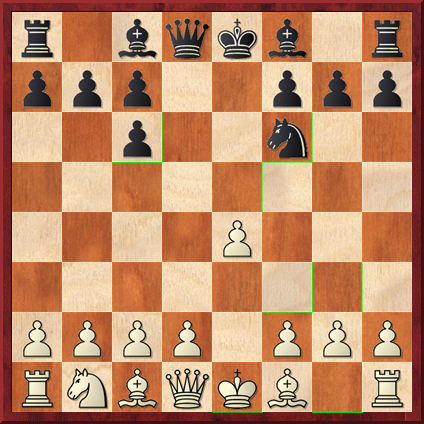
I'm currently writing a Lichess study on the Scotch Gambit/Two Knights Defence position that arises after 1.e4 e5 2.Nf3 Nc6 3.Bc4 Nf6 4.d4 exd4 (or 3.d4 exd4 4.Bc4 Nf6).


I think this is especially worth revisiting because there have been quite a few new developments since I last examined the line in some depth, mainly in the 5.0-0 lines:

(a) 5.0-0 Nxe4 6.Nc3?!, the Nahkmanson Gambit.  


Until recently I had rejected this out of hand, but I was first introduced to one of the key points behind this a couple of years ago at my local chess club (6...dxc3 7.Bxf7+, with the idea of Qd5+, and then usually Re1 followed by recapturing on e4).  It's not very sound, largely because Black can settle for a one-pawn advantage after 6...Nxc3 or 6...Nd6, so I can't recommend it as a serious tournament weapon.  But it has been gaining some popularity at online blitz in particular, where it offers White plenty of hacking chances, especially if Black accepts the piece sacrifice.  Thus, in the study that is currently work in progress I have devoted a chapter to this line.

(b) 5.0-0 Nxe4 6.Re1 d5 7.Bxd5 Qxd5 8.Nc3 Qd7!?.


I don't think I have previously covered that line in much detail, but it has emerged as a serious alternative to the main lines (8...Qa5, 8...Qh5).  It aims to improve over the 8...Qd8 line (Black probably isn't fully equalising after 8...Qd8 9.Rxe4+).  Graham Burgess gave it a good look in his updated version of Chris Baker's A Startling Chess Opening Repertoire.  After 8...Qd7 9.Nxe4 White should be no worse, as White can put the knights onto active posts so that they aren't inferior to Black's knight and bishop, but it is trickier to generate winning chances.

The Max Lange line with 5.0-0 Bc5 6.e5 d5 7.exf6 dxc4 8.fxg7 is now looking roughly equal with best play, although I'd still rather have White in that line, and it's still looking better than the old main line 8.Re1+ Be6 9.Ng5 Qd5.

Via a search of the ChessBase database, I have also found a new try for White in the main line of the Canal Variation (5.0-0 Nxe4 6.Re1 d5 7.Nc3 dxc3 8.Bxd5 Be6 9.Bxe4 Qxd1 10.Rxd1 cxb2 11.Bxb2 f6 12.h4) which complicates matters and so could be a good practical try for rapid games and especially online blitz, though I still think Black's better with best play in that variation and that 7.Nc3 is therefore not as reliable as 7.Bxd5.

My fresh investigations into the 5.e5 lines are only just starting, so I'll have to see if anything new turns up in those.

Monday, 28 June 2021

Managing too much of a monstrosity

I have a confession to make.  

I created the bulk of my site, https://www.ianchessgambits.com/, at a time when I wasn't in full time employment and had plenty of time to devote to thoroughly analysing a wide range of gambits.  In recent years I've been in full time employment and have inevitably had rather less time, and over time it has become rather too daunting for me.  This has resulted in a large number of pages falling into disarray as procrastination set in, my previous site got discontinued, support for Flash disappeared and some of the ChessBase-based replayable diagrams have stopped working properly.  

I haven't been blogging much or updating the site much recently partly because the whole thing has got too much for me to handle and has kept putting me off.  

Had I been older and wiser when I first started the site, I would probably have gone for a more selective, article based approach, possibly more along the lines of what Tim Harding used to do in his excellent ChessCafe.com column, writing about lines that particularly interest me and branching out over time to eventually end up with a pretty comprehensive site.  But then again, some of the tools that are currently available for this sort of thing weren't available back then.  I'm attracted to the idea of doing studies on Lichess.org and creating articles that essentially embed said studies into the articles.  When I first started out, the best PGN viewers were rather more primitive.

I wouldn't want to get rid of what I already have on the site, though.  I'm considering keeping it up as a sort of archive and then reverting to this more article-based approach, but I'm open to other suggestions.  It's not ideal, but I need to change something or I'll just keep on saying that I'm going to push forward with updates and then releasing one or two updates per year if I'm lucky.

In the meantime I've been discovering some famous chess streamers - I chanced upon Eric "Oh no my queen!" Rosen and then branched out from him to Levy Rozman ("GothamChess") and Alexandra Botez (who coined the concept of the "Botez gambit", where you blunder your queen and then do your best to pretend that it was a sacrifice). 


This well-known position arose from 1.e4 e5 2.d4 exd4 3.Nf3 Nc6 4.Bc4 Nf6 5.0-0 Nxe4 6.Re1 d5 7.Bxd5 Qxd5 8.Nc3.  My opponent played 8...Be6??, allowing 9.Nxd5, but somehow I lost because I let Black's d4-pawn run forward and queen.  I played that game a long time ago so can't remember the specifics, but it was one of my most embarrassing losses (though in my defence it was just an online blitz game).  8...Be6?? is the move that most springs to my mind when I think of the Botez gambit.  Anyway, I'm pleased to see these people streaming and stressing the importance of playing chess primarily for fun.

Eric Rosen has been having a lot of fun with the Stafford Gambit (1.e4 e5 2.Nf3 Nf6 3.Nxe5 Nc6?! 4.Nxc6 dxc6) in online blitz games.  


When I first looked at it, I rejected it out of hand, seeing it as basically a tempo-down version of the Boden-Kieseritzky Gambit (which, although dangerous, is not fully sound), but when I looked closely, it's one of those lines that Tim McGrew might refer to as having a high "Caltrop Coefficient" - with best play Black ends up a pawn down for just vague hacking chances, but whereas a slip by Black tends to result in being a pawn down for nothing (which isn't such a big deal at fast time controls, especially online), a slip by White can often lead to instant ruin.  But it's quite telling that in Eric Rosen's recent over-the-board games in Vegas he passed up opportunities to play the Stafford Gambit, preferring the just mildly offbeat 2...Nc6 3.d4 exd4 4.Nxd4 Bb4+ 5.c3 Bc5.  It's one of those lines that can be a lot of fun in online blitz and lead to good attacks, but in slow over the board games risks producing a number of depressing losses and draws where you never really had much for the pawn.

Interestingly one of his other pet lines is the London System (1.d4 and 2.Bf4) which, in contrast, has a reputation of being very solid and very sound, though it can certainly be played in an aggressive way, e.g. involving queenside castling and, if Black goes kingside, throwing forward the kingside pawns.  I guess he doesn't pre-move 2.Bf4, as otherwise the Englund Gambit (1...e5) would become very attractive.

Thursday, 10 December 2020

Getting active on Chess.com during a difficult 2020

 As many will know, the year 2020 has been plagued by the COVID-19 pandemic, which has meant that I have played very little over-the-board chess this year.  However, I have been increasingly actively involved on Chess.com, playing mainly fast games, but also some correspondence type games as well.  It has to be said, though, that even though we're allowed 3 to 7 days per move in those games, in practice I rarely spend much longer on an individual move than I would over the board.

I am a member of a group known as "The Unsound Openers", which seems to me to be very apt, especially as 10-15 years ago I quite often played the Englund Gambit with 1.d4 e5 2.dxe5 Nc6 3.Nf3 Qe7, including using it once in a serious game.  

But when I recently revisited the most critical line of the Englund proper with the aid of Stockfish and Leela Chess Zero, the modern computers have been showing it to be even more unsound than I previously thought.  For example, in the position following 1.d4 e5 2.dxe5 Nc6 3.Nf3 Qe7 4.Bf4 Qb4+ 5.Bd2 Qxb2 6.Nc3 Bb4 7.Rb1 Qa3 8.Nd5! Ba5 9.Rb5 Bxd2+ 10.Qxd2 Kd8 11.e4 a6:


I examined this in some detail with Stefan Bucker back in the late 2000s, and we concluded that Black's defence is very difficult but that with best play Black might be able to hold, with White's poor pawn structure being the main source of hope for Black.  But Stockfish points out that 12.Rb3 Qxa2 13.Bc4! is very strong, with the idea of sacrificing the rook on h1 for an unstoppable attack after 13...Qa1+ 14.Ke2! (14.Qd1? Qxd1+ 15.Kxd1 leaves White with inadequate compensation for a pawn) 14...Qxh1 15.Qg5+ Nge7 16.Nxe7 Nxe7 17.Bxf7.  Black can play 13...Qa5 (or perhaps 12...Qa5 instead of 12...Qxa2) but White's attack appears to be close to winning in all lines.  The line 11.Ng5 Nh6 12.f4, suggested by Boris Avrukh, also appears to be close to winning.

Black's best bets appear to be 5...Qc5 (instead of 5...Qxb2, but this rather defeats the point of the opening) and 8...Bxd2+ 9.Qxd2 Kd8 (instead of 8...Ba5, or 8...Bxd2+ 9.Qxd2 Qxa2, whereupon 10.Rd1 is very strong) but they aren't much fun for Black either.  I had already given up on 3...Qe7 about 10 years ago, and on the rare occasions that I have used 1...e5 since, I have usually gone for 3...Nge7 instead, and these findings are unlikely to change that.

These days my openings tend not to be quite as unsound as that, but there are certainly a fair number that can be said to be at the margins of soundness, including the Blackmar-Diemer, the double pawn sacrifice in the Goring Gambit, the "Smerdon's Scandinavian" complex, the Albin Counter-Gambit and the Ruy Lopez Steinitz Defence Deferred piece sacrifice line 4...d6 5.0-0 Bg4 6.h3 h5.

I'm hoping that progress will pick up on updating my main chess website soon, as I've got to grips with the Chess.com game/analysis replayer (which you can also embed onto a website, at least if you have some sort of premium membership on there - I recently went for Gold, which is the least expensive) and I hope it might address the problem with the ChessBase replayer, which tends to have many levels of nested variations which can be hard to follow for some.  I note that Jonathan's blog 200 Open Games has been using the Chess.com replayer for a while.

Wednesday, 18 December 2019

Fun with a chess variant

As I prepare for another revamp of my main chess site, here's a bit of light entertainment.

At Exeter Chess Club I was recently playing in a chess variants tournament.  One of my favourites is the variant where if the king reaches one of the central squares (e4, d4, e5, d5) it is an automatic win for the player whose king reaches that square.  Otherwise normal rules of chess apply.  I was playing Black and reached the following position with White to move:


I had given up a queen for a rook in order to get my king out to d6.  In normal chess this position would be a straightforward win for White, but in this chess variant White has to be extremely careful as Black is only one move away from bringing the black king to the central squares and winning.

In the game White played 1.Qxe4 and resigned immediately after 1...Re8!.  In a normal game 2.Qxe8 would win, but in this chess variant, 2.Qxe8 would be met by 2...Kd5 0-1.  And if 2.Qxf5, Black wins normally with 2...Re1#, exploiting the weakness of the back rank.

A question is whether White can save this position despite being a queen for a rook ahead - this is the sort of chess variant that wouldn't work with computer analysis.  An obvious try is 1.Qb5, covering the central squares for the time being, but after 1...Nd4 2,Qg5 f5 or 2.Qa5 b5, White is struggling to keep the central squares covered and stop the black king from advancing.  1.Qa5 is probably best, but White has to watch out for ...Rc8-c5 and ...Re8-e5 ideas.

The opening saw me on the black side of a Four Knights Game (via an unusual move order, 1.Nc3 Nc6 2.Nf3 e5 3.e4 Nf6 I think).  My opponent then played 4.Bc4, allowing 4...Nxe4.  He remarked afterwards that in this chess variant the Halloween Gambit (4.Nxe5, the subject of my Halloween update to my website) would have been strong as in various variations it is difficult for Black to stop White from safely moving the king forward towards the centre.

I imagine that the Mason Gambit (1.e4 e5 2.f4 exf4 3.Nc3!?) and the allied Steinitz Gambit (1.e4 e5 2.Nc3 Nc6 3.f4 exf4 4.d4!?), inviting ...Qh4+, forcing Ke2, would also be good in this particular variant.

Thursday, 7 March 2019

A "very nearly brilliancy" in the Morra

I had a "very nearly brilliancy" in the Morra a couple of days ago, where I played what was probably my best ever attack up to move 21, sacrificing a piece and then an exchange in order to get a winning attack, but then threw it all away at move 22.  I had actually planned 22.Bh6 in advance, but talked myself out of playing it, thinking that 22.Be7 was "safer" because the bishop was defended by the queen...

The game began

1. e4 c5 2. d4 cxd4 3. Nf3 Nc6 4. c3 dxc3 5. Nxc3 g6 6. Bc4 d6 7. Qb3


Hitting f7, and encouraging ...e6, whereupon Black's Dragon formation "loses its shape", as Marc Esserman puts it in his book.

7...e6 8. O-O Nf6 9. Rd1 Qe7 $6 10. Bg5 

10. Bf4 is even stronger, with the idea of encouraging Black to weaken d5 further with 10...e5 11. Bg5.

10... a6?

10... Bg7 was best, and then if 11. Nd5?! (11. Bf4) (11. Nb5) 11... exd5 12. exd5 O-O
13. dxc6 bxc6.


11. Nd5

11. Bd5! was even stronger, but sacrificing the knight is the second best move in the position.

11... exd5 12. exd5 Ne5

12... Bg7 13. dxc6 O-O is objectively best, but then White has attacking
chances and the better pawn structure in a position with level material, and
the black pawn on d6 will probably drop off.

13. Nxe5 Qxe5

13... dxe5 14. d6 gives White a winning attack.

14. Re1

14. f4! would have been even stronger, preventing Black's ...Ne4 idea, but a couple of lines have to be calculated accurately.  The move played in the game is also winning for White, though.

14... Ne4


15. Rxe4! Qxe4 16. Qc3! Qe5

I saw 16... Bg7 17. Qxg7 Rf8 18. Bh6 Qe7 19. Qc3 renewing the threat of Re1.

16...f6 17. Re1 Qxe1+ 18. Qxe1+ Kf7 is Black's best chance, whereupon White has to
find 19.Bxf6! to get a winning position.

17. Re1 Bg7
17... Qxe1+ 18.Qxe1+ Kd7 gives White a choice of winning continuations. For example, 19. Bf6 Rg8 20. Qe3 b5 (20... Kc7 21. Qe8) 21. Qb6! forces mate.)

18. f4!

18. Rxe5+? Bxe5 followed by ...0-0 is probably alright for Black.

18...Qxe1+ 19. Qxe1+ Kf8 20. Qe7+ Kg8 21. Qe8+ Bf8 


Unfortunately this is the point where I bottled it.  22.Bh6, which was my original intention, forces mate in four moves, but I somehow convinced myself that Black could wriggle out, and consequently played a "safer" move that allowed Black to wriggle out...

22. Be7?? Kg7! 23. Bxf8+?! 

As is often the case after the psychological blow of missing a quick win, I rather went to
pieces. 23. Bh4 would still have left White with a strong, possibly winning,
attack.

23... Rxf8 24. Qe4?! Bf5 25. Qd4+ Kg8 26. Qb6 Rac8 27. Bb3?! Rfe8 and Black went on to win.

Unfortunately I have been forced to link to the game rather than embed a replayable game into the blog post, because at least at my end I seem to have triggered some sort of block that is stopping me from viewing replayable chess games in my own blog (but not other people's blogs).

 http://view.chessbase.com/cbreader/2019/3/7/Game19546281.html

An agonising loss, but I do seem to have improved my attacking play a bit recently - a common past failing of mine has been to be too eager to "cash in" and missing the quiet moves (like 16.Qc3 and 18.f4 in the above game).  I think had I reached the position at move 15 this time last year I would probably have been preoccupied with trying to regain the piece with f2-f3 and it is unlikely that I would have had the guts to play 15.Rxe4.

Having seen a number of AlphaZero-Stockfish matches recently, I think I may well have been inspired by AlphaZero's willingness to sacrifice pawns and even pieces and then quietly improve its position.