Wednesday, 1 October 2025

A first encounter with the von Hennig-Schara Gambit... on the white side!

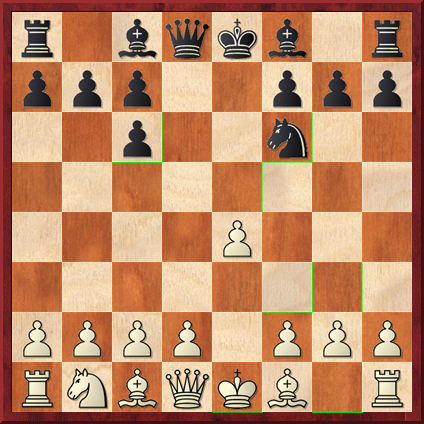
 I am not exclusively an 1.e4 player, and in a recent online game I tried the Queen's Gambit (1.d4 d5 2.c4). In my Exeter days I also used this occasionally and had some exciting games against a Slav player which went 2...c6 3.Nc3 e6 4.Nf3 dxc4 and then I turned it into a real gambit with 5.e4 b5. But on this occasion, the hunter became the hunted, as I met with the von Hennig-Schara Gambit: 2...e6 3.Nc3 c5 4.cxd5 cxd4!?.


I haven't played this with Black (not yet, anyway) as I have been having too much fun with the Albin Counter-Gambit, and have occasionally experimented with the Slav, but I think it's a pretty reasonable gambit. The main line then goes 5.Qa4+ Bd7 6.Qxd4 exd5 7.Qxd5 Nc6, but I allowed my opponent a couple of additional options by playing 5.Qxd4 Nc6 6.Qd1 exd5 7.Qxd5. Here most players transpose with 7...Bd7, but 7...Bd6 and 7...Be6 are both possible.

When I was growing up in the 1990s and early 2000s, usually the recommended approach for Black was to castle queenside and go for a kingside pawn storm, but with a normal edge for White. But a few recent articles (e.g. by Nigel Davies over at Chesspublishing) have been suggesting that Black is doing better by castling short and relying on piece play. I also saw a ChessPub forum post from a couple of years ago by MNb which suggested that Black's queenside castling plan is close to refuted if White plays a3 and then meets ...g7-g5-g4 with Nh4. 

The latest version of Stockfish agrees with all of this. The most critical position arises after 7...Bd7 8.Nf3 Nf6 9.Qd1 Bc5 10.e3 Qe7 11.Be2...


Here Stockfish assesses 11...0-0 as about +0.5 for White, which I reckon is pretty decent for a gambit with the black pieces. In the Lumbras GigaBase Black has played this line in a number of grandmaster level games with reasonable results, and in some of them Black still ends up building a kingside attack, while White doesn't have much in the way of attacking chances. Black tends to follow up with ...Rfd8 and ...Ne5.

But the line with 11...0-0-0 12.0-0 g5 13.a3 g4 14.Nh4 is assessed as close to +1. Looking over the games, Black still gets attacking chances here, but Black's attack is slowed down quite a bit and White's attacking chances on the queenside are as good as Black's on the kingside, hence the engine assessment of Black having very little compensation for the pawn. On the other hand, in the database, White has only got this far in seven games out of 528, and Black's results after 11...0-0-0 have been quite good overall. Thus, it looks to me that at most levels of play, the ...0-0-0 lines will be fine most of the time, but they do involve taking the risk that if one encounters a well prepared opponent, one may come out of the opening with a substantial disadvantage. Thus, since around 2005, 11...0-0 has increasingly surpassed 11...0-0-0 in popularity at high levels.

I guess I had mixed feelings when my opponent deviated with 7...Be6 8.Qxd8 Rxd8.


This is an example of where computer evaluations can only get you so far, as Stockfish reckons that this line isn't substantially inferior, assessing it as +0.6 for White, but I reckon that in practice it is substantially inferior. With the queens off, Black has to play more accurately in order to maintain some compensation for the pawn. I continued with 9.e3, preventing ...Nd4, and my opponent was a little hesitant, so I ended up trading down into a winning king and pawn endgame - probably the biggest risk associated with playing gambits, but this time I was the one defending against one.

From a practical/results point of view, this was a good outcome, but I think a far more interesting game would have ensued if my opponent had gone ...Bd7, or the less common ...Bd6, I was happy to take on the challenge of meeting one of Black's more aggressive approaches.

Wednesday, 24 September 2025

It's been a while... revisiting the Nxc3 lines of the Göring and Danish

I realise I haven't posted on here for three years. I have still been quite active in the chess community, playing mainly on Chess.com and more recently at Lincoln Chess Club. 

I haven't done any blogs over at Chess.com since 2013, but this week I published an extensive blog/article where I revisited the Danish and Göring Gambits, specifically the lines where White's c3 is met with ...dxc3 and then Nxc3. 

I decided to combine both gambits, as it tied in well with discussing the various transpositions and independent possibilities arising from the move order 1.e4 e5 2.d4 exd4 3.c3 dxc3 4.Nxc3. GM Daniel Naroditsky has recommended 4...Bc5 there, with the idea of following up with ...Nbd7 and ...c6 instead of ...Nc6, which takes some of the sting out of White's Bg5/Nd5 plans. I remember noting that possibility a couple of decades ago when it was briefly covered in Danish Dynamite via the move order 1.e4 e5 2.d4 exd4 3.Nf3 Bc5 4.c3 dxc3 5.Nxc3, where Zezulkin-Plachetka continued 5...d6 6.Bc4 Nf6 7.0-0 Nc6, transposing into the Göring, when Black could instead have tried 7...0-0 and then ...Nbd7 and ...c6. But when I looked over these lines, they don't look that bad for White to me. Black might get a tiny edge if both sides play perfectly, but that's also the case in some other lines, and White has the usual practical chances.

I was inspired to revisit those lines by FM William Graif's YouTube channel, where he has advocated the Göring in some of his videos, including the sideline that I have often used myself, 4...d5 5.Bd3. I also found that there have been quite a number of high level games played in these lines since I last examined them extensively around the mid-2010s, including two by Vasly Ivanchuk, who has been having a bit of a renaissance recently, I think he's just short of rating in the world's top 100 at the moment.

I note that my last blog discussed the Euwe Defence in the Blackmar-Diemer. I have had that line in quite a few games recently, often via transposition from the French Defence, and regardless of the theoretical assessment I have been sticking with the line (1.d4 d5 2.e4 dxe4 3.Nc3 Nf6 4.f3 exf3 5.Nxf3 e6) 6.Bg5 Be7 7.Qd2 and doing rather well.

The BDG is looking rather less sound than the Göring at the moment - when I run Stockfish 17 on my current PC, the Stockfish evaluation of the BDG is around -0.5 whereas the Göring is -0.1 to -0.2 - and if I'm honest I see little reason to doubt Stockfish's assessment - but there are still plenty of practical chances there too. Last week I had a game at the local club which reached the following position via that 7.Qd2 line of the Euwe Defence:


Here Rxh5, gxh5, Qf6# was a nice finish.


Sunday, 11 December 2022

Some re-examination of the Blackmar-Diemer Gambit, Euwe Defence, Qe2 ideas

 I was recently re-reading Christoph Scheerer's chapter on the Euwe Defence with 1.d4 d5 2.e4 dxe4 3.Nc3 Nf6 4.f3 exf3 5.Nxf3 e6 and seeing that in several lines he likes the idea of Bd3 followed by Qe2.  I wondered if I could find something new involving Qe2 in positions where he doesn't mention the idea.

My first experiment was a failure.  Following 6.Bg5 Be7 7.Bd3 Nc6,


I've seen 8.a3 and 8.Qd2 suggested, and Lev Zilbermints has favoured the second pawn sacrifice 8.0-0 Nxd4 9.Kh1, but I wondered if 8.Qe2 might work, because after 8...Nxd4 9.Nxd4 Qxd4 10.0-0-0, White has a long lead in development and the black queen is facing the white rook on d1.


Unfortunately for me, Stockfish inconveniently points out 10...Qg4!, when White has to spend another tempo moving the queen, and Black is able to get time to consolidate.

Another variation where Christoph Scheerer doesn't mention the Qe2 possibility is after 7...c5 8.dxc5 (here 8.Qe2?! cxd4 doesn't work) Qa5.

Here he only gives the main line 9.0-0 Qxc5+ 10.Kh1, which, to be fair, gives White a fair amount of compensation for the pawn.  But here 9.Qe2!? looks quite good, e.g. 9...Nbd7 10.0-0-0 Nxc5 (10...0-0 11.h4 improves over the 11.Kb1 of Toussaint-Mercky, France 1999).


Now White has various options including Ne5 and Rhf1, keeping up a fair amount of pressure on the black position, and if Black plays ...Nxd3+, White can answer with Rxd3.

Generally I think these days that 7.Bd3 c5 (as recommended by Joe Gallagher and James Rizzitano some time ago) is not so challenging for White, and that the traditional main line 7...Nc6 is the most critical.  

I have most often played 7.Qd2 (instead of 7.Bd3) when I have had this line with White, but I am not sure about White's compensation after 7...c5, which is why I decided to revisit the traditional 7.Bd3.

Monday, 3 October 2022

Duck Chess gets some mainstream recognition

I haven't posted here for a while, but I haven't left the chess world.

During my long stint at Exeter Chess Club, Tim Paulden invented a new chess variant called Duck Chess, and we had quite a few informal "chess variants" tournaments that featured it.  

Recently, it has started to gain more mainstream recognition as Chess.com has added it to their list of chess variants.  Over the past week several of the most prominent chess streamers, including Eric Rosen and Jonathan Schrantz, have picked up on it and tried it out on Chess.com.  

Essentially, you make a move and then you place the yellow duck on a square, and the duck serves as a blocker (so for instance if you play 1.e4 with White, and you don't want your opponent playing the Sicilian Defence, 1...c5, you can annoy them by putting the duck on c6 so that they can't move the c-pawn).  The technique for how to checkmate opponents in Duck Chess is rather different to the standard game of chess.  You can get some nice smothered duck mates with a knight, but if you try to deliver checkmates with the queen, and there's some distance between the queen and king, your opponent can keep blocking with the duck.  I remember learning that the hard way a few times when I was down in Exeter, and Eric Rosen found it out starkly towards the end of his game.

Meanwhile, over the past year I've really got into Levy "GothamChess" Rozman's series Guess the Elo, and the latest episode was particularly amusing for the variable quality of the play.

In addition to this I've been actively involved with a Chess.com group called The Unsound Openers, who tend to dabble in a range of gambits from the blatantly unsound to ones that are near the margins of soundness, as well as some offbeat lines like the Borgcloud and the Grob.  There's plenty of unorthodox openings around on the YouTube channels of Eric Rosen and Jonathan Schrantz and to a lesser extent GothamChess, who I now follow regularly. 

Sunday, 31 October 2021

Another suitably festive post for Halloween

 I remember that one of my most recent updates to my site was on Halloween and featured an article on the Halloween Gambit.  I still need to update the site to address the fact that some pages are in disarray, but so far "life" has been getting in the way of me completing that.  I hope to manage it at some point in the next few weeks.

With it being Halloween, I've completed my first complete Lichess study (I've also got a couple ongoing on the Scotch Gambit and the Blackmar-Diemer Gambit) which is on the Halloween Gambit.

My conclusion is unchanged though from last time: it's dangerous, but unsound. I recently played in a Chess.com thematic tournament where I played the 7...d5 line with Black and converted the extra piece, although my opponent missed an opportunity to complicate matters.  When I played White, my opponent went 7...Bb4 instead, and I had an opportunity to generate a strong, if not winning, attack, but I missed my chance and lost.

As I mentioned in the Introduction, Black can try to transpose to the Stafford Gambit (1.e4 e5 2.Nf3 Nf6 3.Nxe5 Nc6) with 4...Bc5.  Objectively the transposition with 5.Nxc6 dxc6 is good for White, but I'm inclined to suggest 5.Nf3 instead, which allows White to retain an extra pawn without permitting Black as many hacking chances as in the Stafford Gambit.  I'm currently playing in a Chess.com thematic tournament in the Stafford, as it happens (the first time that I've ever played it with either colour), and have so far got good positions with both colours, but it's still early days there.

A good source on the Halloween Gambit and the history of it is Tim Krabbe's site at https://timkr.home.xs4all.nl/tour/breeze.htm  My investigations seem to bear out the old masters' view that the lines ending 7...d5 and 7...c6 (Chapters 9 & 11) are the biggest test for White, but White still gets some (but objectively not enough) long term attacking chances there.

Sunday, 4 July 2021

Revisiting the Scotch Gambit: the Two Knights Defence with d4

I'm currently writing a Lichess study on the Scotch Gambit/Two Knights Defence position that arises after 1.e4 e5 2.Nf3 Nc6 3.Bc4 Nf6 4.d4 exd4 (or 3.d4 exd4 4.Bc4 Nf6).


I think this is especially worth revisiting because there have been quite a few new developments since I last examined the line in some depth, mainly in the 5.0-0 lines:

(a) 5.0-0 Nxe4 6.Nc3?!, the Nahkmanson Gambit.  


Until recently I had rejected this out of hand, but I was first introduced to one of the key points behind this a couple of years ago at my local chess club (6...dxc3 7.Bxf7+, with the idea of Qd5+, and then usually Re1 followed by recapturing on e4).  It's not very sound, largely because Black can settle for a one-pawn advantage after 6...Nxc3 or 6...Nd6, so I can't recommend it as a serious tournament weapon.  But it has been gaining some popularity at online blitz in particular, where it offers White plenty of hacking chances, especially if Black accepts the piece sacrifice.  Thus, in the study that is currently work in progress I have devoted a chapter to this line.

(b) 5.0-0 Nxe4 6.Re1 d5 7.Bxd5 Qxd5 8.Nc3 Qd7!?.


I don't think I have previously covered that line in much detail, but it has emerged as a serious alternative to the main lines (8...Qa5, 8...Qh5).  It aims to improve over the 8...Qd8 line (Black probably isn't fully equalising after 8...Qd8 9.Rxe4+).  Graham Burgess gave it a good look in his updated version of Chris Baker's A Startling Chess Opening Repertoire.  After 8...Qd7 9.Nxe4 White should be no worse, as White can put the knights onto active posts so that they aren't inferior to Black's knight and bishop, but it is trickier to generate winning chances.

The Max Lange line with 5.0-0 Bc5 6.e5 d5 7.exf6 dxc4 8.fxg7 is now looking roughly equal with best play, although I'd still rather have White in that line, and it's still looking better than the old main line 8.Re1+ Be6 9.Ng5 Qd5.

Via a search of the ChessBase database, I have also found a new try for White in the main line of the Canal Variation (5.0-0 Nxe4 6.Re1 d5 7.Nc3 dxc3 8.Bxd5 Be6 9.Bxe4 Qxd1 10.Rxd1 cxb2 11.Bxb2 f6 12.h4) which complicates matters and so could be a good practical try for rapid games and especially online blitz, though I still think Black's better with best play in that variation and that 7.Nc3 is therefore not as reliable as 7.Bxd5.

My fresh investigations into the 5.e5 lines are only just starting, so I'll have to see if anything new turns up in those.

Monday, 28 June 2021

Managing too much of a monstrosity

I have a confession to make.  

I created the bulk of my site, https://www.ianchessgambits.com/, at a time when I wasn't in full time employment and had plenty of time to devote to thoroughly analysing a wide range of gambits.  In recent years I've been in full time employment and have inevitably had rather less time, and over time it has become rather too daunting for me.  This has resulted in a large number of pages falling into disarray as procrastination set in, my previous site got discontinued, support for Flash disappeared and some of the ChessBase-based replayable diagrams have stopped working properly.  

I haven't been blogging much or updating the site much recently partly because the whole thing has got too much for me to handle and has kept putting me off.  

Had I been older and wiser when I first started the site, I would probably have gone for a more selective, article based approach, possibly more along the lines of what Tim Harding used to do in his excellent ChessCafe.com column, writing about lines that particularly interest me and branching out over time to eventually end up with a pretty comprehensive site.  But then again, some of the tools that are currently available for this sort of thing weren't available back then.  I'm attracted to the idea of doing studies on Lichess.org and creating articles that essentially embed said studies into the articles.  When I first started out, the best PGN viewers were rather more primitive.

I wouldn't want to get rid of what I already have on the site, though.  I'm considering keeping it up as a sort of archive and then reverting to this more article-based approach, but I'm open to other suggestions.  It's not ideal, but I need to change something or I'll just keep on saying that I'm going to push forward with updates and then releasing one or two updates per year if I'm lucky.

In the meantime I've been discovering some famous chess streamers - I chanced upon Eric "Oh no my queen!" Rosen and then branched out from him to Levy Rozman ("GothamChess") and Alexandra Botez (who coined the concept of the "Botez gambit", where you blunder your queen and then do your best to pretend that it was a sacrifice). 


This well-known position arose from 1.e4 e5 2.d4 exd4 3.Nf3 Nc6 4.Bc4 Nf6 5.0-0 Nxe4 6.Re1 d5 7.Bxd5 Qxd5 8.Nc3.  My opponent played 8...Be6??, allowing 9.Nxd5, but somehow I lost because I let Black's d4-pawn run forward and queen.  I played that game a long time ago so can't remember the specifics, but it was one of my most embarrassing losses (though in my defence it was just an online blitz game).  8...Be6?? is the move that most springs to my mind when I think of the Botez gambit.  Anyway, I'm pleased to see these people streaming and stressing the importance of playing chess primarily for fun.

Eric Rosen has been having a lot of fun with the Stafford Gambit (1.e4 e5 2.Nf3 Nf6 3.Nxe5 Nc6?! 4.Nxc6 dxc6) in online blitz games.  


When I first looked at it, I rejected it out of hand, seeing it as basically a tempo-down version of the Boden-Kieseritzky Gambit (which, although dangerous, is not fully sound), but when I looked closely, it's one of those lines that Tim McGrew might refer to as having a high "Caltrop Coefficient" - with best play Black ends up a pawn down for just vague hacking chances, but whereas a slip by Black tends to result in being a pawn down for nothing (which isn't such a big deal at fast time controls, especially online), a slip by White can often lead to instant ruin.  But it's quite telling that in Eric Rosen's recent over-the-board games in Vegas he passed up opportunities to play the Stafford Gambit, preferring the just mildly offbeat 2...Nc6 3.d4 exd4 4.Nxd4 Bb4+ 5.c3 Bc5.  It's one of those lines that can be a lot of fun in online blitz and lead to good attacks, but in slow over the board games risks producing a number of depressing losses and draws where you never really had much for the pawn.

Interestingly one of his other pet lines is the London System (1.d4 and 2.Bf4) which, in contrast, has a reputation of being very solid and very sound, though it can certainly be played in an aggressive way, e.g. involving queenside castling and, if Black goes kingside, throwing forward the kingside pawns.  I guess he doesn't pre-move 2.Bf4, as otherwise the Englund Gambit (1...e5) would become very attractive.

Thursday, 10 December 2020

Getting active on Chess.com during a difficult 2020

 As many will know, the year 2020 has been plagued by the COVID-19 pandemic, which has meant that I have played very little over-the-board chess this year.  However, I have been increasingly actively involved on Chess.com, playing mainly fast games, but also some correspondence type games as well.  It has to be said, though, that even though we're allowed 3 to 7 days per move in those games, in practice I rarely spend much longer on an individual move than I would over the board.

I am a member of a group known as "The Unsound Openers", which seems to me to be very apt, especially as 10-15 years ago I quite often played the Englund Gambit with 1.d4 e5 2.dxe5 Nc6 3.Nf3 Qe7, including using it once in a serious game.  

But when I recently revisited the most critical line of the Englund proper with the aid of Stockfish and Leela Chess Zero, the modern computers have been showing it to be even more unsound than I previously thought.  For example, in the position following 1.d4 e5 2.dxe5 Nc6 3.Nf3 Qe7 4.Bf4 Qb4+ 5.Bd2 Qxb2 6.Nc3 Bb4 7.Rb1 Qa3 8.Nd5! Ba5 9.Rb5 Bxd2+ 10.Qxd2 Kd8 11.e4 a6:


I examined this in some detail with Stefan Bucker back in the late 2000s, and we concluded that Black's defence is very difficult but that with best play Black might be able to hold, with White's poor pawn structure being the main source of hope for Black.  But Stockfish points out that 12.Rb3 Qxa2 13.Bc4! is very strong, with the idea of sacrificing the rook on h1 for an unstoppable attack after 13...Qa1+ 14.Ke2! (14.Qd1? Qxd1+ 15.Kxd1 leaves White with inadequate compensation for a pawn) 14...Qxh1 15.Qg5+ Nge7 16.Nxe7 Nxe7 17.Bxf7.  Black can play 13...Qa5 (or perhaps 12...Qa5 instead of 12...Qxa2) but White's attack appears to be close to winning in all lines.  The line 11.Ng5 Nh6 12.f4, suggested by Boris Avrukh, also appears to be close to winning.

Black's best bets appear to be 5...Qc5 (instead of 5...Qxb2, but this rather defeats the point of the opening) and 8...Bxd2+ 9.Qxd2 Kd8 (instead of 8...Ba5, or 8...Bxd2+ 9.Qxd2 Qxa2, whereupon 10.Rd1 is very strong) but they aren't much fun for Black either.  I had already given up on 3...Qe7 about 10 years ago, and on the rare occasions that I have used 1...e5 since, I have usually gone for 3...Nge7 instead, and these findings are unlikely to change that.

These days my openings tend not to be quite as unsound as that, but there are certainly a fair number that can be said to be at the margins of soundness, including the Blackmar-Diemer, the double pawn sacrifice in the Goring Gambit, the "Smerdon's Scandinavian" complex, the Albin Counter-Gambit and the Ruy Lopez Steinitz Defence Deferred piece sacrifice line 4...d6 5.0-0 Bg4 6.h3 h5.

I'm hoping that progress will pick up on updating my main chess website soon, as I've got to grips with the Chess.com game/analysis replayer (which you can also embed onto a website, at least if you have some sort of premium membership on there - I recently went for Gold, which is the least expensive) and I hope it might address the problem with the ChessBase replayer, which tends to have many levels of nested variations which can be hard to follow for some.  I note that Jonathan's blog 200 Open Games has been using the Chess.com replayer for a while.

Wednesday, 18 December 2019

Fun with a chess variant

As I prepare for another revamp of my main chess site, here's a bit of light entertainment.

At Exeter Chess Club I was recently playing in a chess variants tournament.  One of my favourites is the variant where if the king reaches one of the central squares (e4, d4, e5, d5) it is an automatic win for the player whose king reaches that square.  Otherwise normal rules of chess apply.  I was playing Black and reached the following position with White to move:


I had given up a queen for a rook in order to get my king out to d6.  In normal chess this position would be a straightforward win for White, but in this chess variant White has to be extremely careful as Black is only one move away from bringing the black king to the central squares and winning.

In the game White played 1.Qxe4 and resigned immediately after 1...Re8!.  In a normal game 2.Qxe8 would win, but in this chess variant, 2.Qxe8 would be met by 2...Kd5 0-1.  And if 2.Qxf5, Black wins normally with 2...Re1#, exploiting the weakness of the back rank.

A question is whether White can save this position despite being a queen for a rook ahead - this is the sort of chess variant that wouldn't work with computer analysis.  An obvious try is 1.Qb5, covering the central squares for the time being, but after 1...Nd4 2,Qg5 f5 or 2.Qa5 b5, White is struggling to keep the central squares covered and stop the black king from advancing.  1.Qa5 is probably best, but White has to watch out for ...Rc8-c5 and ...Re8-e5 ideas.

The opening saw me on the black side of a Four Knights Game (via an unusual move order, 1.Nc3 Nc6 2.Nf3 e5 3.e4 Nf6 I think).  My opponent then played 4.Bc4, allowing 4...Nxe4.  He remarked afterwards that in this chess variant the Halloween Gambit (4.Nxe5, the subject of my Halloween update to my website) would have been strong as in various variations it is difficult for Black to stop White from safely moving the king forward towards the centre.

I imagine that the Mason Gambit (1.e4 e5 2.f4 exf4 3.Nc3!?) and the allied Steinitz Gambit (1.e4 e5 2.Nc3 Nc6 3.f4 exf4 4.d4!?), inviting ...Qh4+, forcing Ke2, would also be good in this particular variant.

Thursday, 7 March 2019

A "very nearly brilliancy" in the Morra

I had a "very nearly brilliancy" in the Morra a couple of days ago, where I played what was probably my best ever attack up to move 21, sacrificing a piece and then an exchange in order to get a winning attack, but then threw it all away at move 22.  I had actually planned 22.Bh6 in advance, but talked myself out of playing it, thinking that 22.Be7 was "safer" because the bishop was defended by the queen...

The game began

1. e4 c5 2. d4 cxd4 3. Nf3 Nc6 4. c3 dxc3 5. Nxc3 g6 6. Bc4 d6 7. Qb3


Hitting f7, and encouraging ...e6, whereupon Black's Dragon formation "loses its shape", as Marc Esserman puts it in his book.

7...e6 8. O-O Nf6 9. Rd1 Qe7 $6 10. Bg5 

10. Bf4 is even stronger, with the idea of encouraging Black to weaken d5 further with 10...e5 11. Bg5.

10... a6?

10... Bg7 was best, and then if 11. Nd5?! (11. Bf4) (11. Nb5) 11... exd5 12. exd5 O-O
13. dxc6 bxc6.


11. Nd5

11. Bd5! was even stronger, but sacrificing the knight is the second best move in the position.

11... exd5 12. exd5 Ne5

12... Bg7 13. dxc6 O-O is objectively best, but then White has attacking
chances and the better pawn structure in a position with level material, and
the black pawn on d6 will probably drop off.

13. Nxe5 Qxe5

13... dxe5 14. d6 gives White a winning attack.

14. Re1

14. f4! would have been even stronger, preventing Black's ...Ne4 idea, but a couple of lines have to be calculated accurately.  The move played in the game is also winning for White, though.

14... Ne4


15. Rxe4! Qxe4 16. Qc3! Qe5

I saw 16... Bg7 17. Qxg7 Rf8 18. Bh6 Qe7 19. Qc3 renewing the threat of Re1.

16...f6 17. Re1 Qxe1+ 18. Qxe1+ Kf7 is Black's best chance, whereupon White has to
find 19.Bxf6! to get a winning position.

17. Re1 Bg7
17... Qxe1+ 18.Qxe1+ Kd7 gives White a choice of winning continuations. For example, 19. Bf6 Rg8 20. Qe3 b5 (20... Kc7 21. Qe8) 21. Qb6! forces mate.)

18. f4!

18. Rxe5+? Bxe5 followed by ...0-0 is probably alright for Black.

18...Qxe1+ 19. Qxe1+ Kf8 20. Qe7+ Kg8 21. Qe8+ Bf8 


Unfortunately this is the point where I bottled it.  22.Bh6, which was my original intention, forces mate in four moves, but I somehow convinced myself that Black could wriggle out, and consequently played a "safer" move that allowed Black to wriggle out...

22. Be7?? Kg7! 23. Bxf8+?! 

As is often the case after the psychological blow of missing a quick win, I rather went to
pieces. 23. Bh4 would still have left White with a strong, possibly winning,
attack.

23... Rxf8 24. Qe4?! Bf5 25. Qd4+ Kg8 26. Qb6 Rac8 27. Bb3?! Rfe8 and Black went on to win.

Unfortunately I have been forced to link to the game rather than embed a replayable game into the blog post, because at least at my end I seem to have triggered some sort of block that is stopping me from viewing replayable chess games in my own blog (but not other people's blogs).

 http://view.chessbase.com/cbreader/2019/3/7/Game19546281.html

An agonising loss, but I do seem to have improved my attacking play a bit recently - a common past failing of mine has been to be too eager to "cash in" and missing the quiet moves (like 16.Qc3 and 18.f4 in the above game).  I think had I reached the position at move 15 this time last year I would probably have been preoccupied with trying to regain the piece with f2-f3 and it is unlikely that I would have had the guts to play 15.Rxe4.

Having seen a number of AlphaZero-Stockfish matches recently, I think I may well have been inspired by AlphaZero's willingness to sacrifice pawns and even pieces and then quietly improve its position.

Sunday, 3 June 2018

RIP Valeri Yandemirov

I've just found out via Chessdom.com that Valeri Yandemirov passed away last year at the age of 55:
http://www.chessdom.com/in-memoriam-gm-valeri-yandemirov/

Not a household name, but he was a grandmaster with a peak rating of 2545 in 1998, and he was rated in the 2500s for most of the "noughties" as well.

The main reason why the name sticks out for me is that he was a big practitioner of two daring and sacrificial lines in the Ruy Lopez Modern Steinitz Defence: the Siesta Variation (1.e4 e5 2.Nf3 Nc6 3.Bb5 a6 4.Ba4 d6 5.c3 f5) and the line 5.0-0 Bg4 6.h3 h5, which some have started naming after him (notably Timothy Taylor in his book Slay the Spanish).  The idea most commonly associated with Yandemirov was, after 7.d4 b5 8.Bb3 Nxd4 9.hxg4, to play 9...Nxb3 (instead of 9...hxg4 10.Ng5 Nh6, which has been shown to be insufficient for Black) 10.axb3 hxg4 11.Ng5 Qd7.


 Black is currently a piece down but can generally regain the piece with ...f6 and ...fxg5 since the knight on g5 has no retreat square.  The main idea is however to play ...Qf7 and ...Qh5 and try to mate White down the h-file.  On the other hand this line is still theoretically dodgy because in the meantime White can smash Black on the queenside.  The line was dealt quite a heavy blow in the game Gashimov-Grischuk, Baku 2008: http://www.chessgames.com/perl/chessgame?gid=1492751

Nowadays, while 4...d6 has seen some popularity at the highest levels, GMs such as Shakhriyar Mamedyarov and Nigel Short have tended to prefer 5...Bd7 over 5...Bg4, but the 5...Bg4 line has still seen a few recent GM outings, particularly in the hands of Laurent Fressinet: http://www.chessgames.com/perl/chessgame?gid=1902468

Aseev-Yandemirov, Krasnoyarsk 2003 was arguably the greatest advert for his pet line:
http://www.chessgames.com/perl/chessgame?gid=1267372

I have tried these lines out myself from time to time since 2009 and currently have an online game that has reached the position after 6.h3 h5.  I tend to think that if it can work at GM level it must be good enough for mere mortals, even though it may be of marginal theoretical soundness.


Monday, 16 April 2018

An intriguing transposition from the Albin Counter-Gambit into the Göring Gambit Declined

I've probably mentioned the transposition from the Chigorin Defence before (it was also mentioned about a year and a half ago over at 200 Open Games).  Recently I managed to get it in one of my own online games, fittingly, in a Chess.com match between "The Gambit Players" and "Philippine C", and it actually started out as an Albin Counter-Gambit: 1.d4 d5 2.c4 e5, and White replied with the tame 3.e3.  After 3...Nc6 4.cxd5 Qxd5 we were into a Chigorin, and after 5.Nc3 Bb4 6.Nf3 exd4 7.exd4 we were into a Göring/Danish Gambit Declined.

Capablanca's line with 7...Bg4 8.Be2 (8.Be3!? - Mark Nieuweboer) 8...Bxf3 9.Bxf3 Qc4 gets pretty sterile if White knows what he/she is doing, so I was tempted to duck out with the sensible 8...Nf6, but as I was playing a slightly higher-rated player with Black I thought I would test my opponent out in the Capablanca Variation.  It worked, for after 7...Bg4 8.Be2 Bxf3 9.Bxf3 Qc4 10.Bd2?! 0-0-0 11.Qe2?! Qxe2+ 12.Bxe2 Nxd4 I was already a pawn up and managed to win with the extra pawn after a long struggle.

In the meantime I finally had an outing in the line that I had corresponded with Gary Lane about over at Opening Lanes (Chesscafe.com):  1.e4 e5 2.d4 exd4 3.Nf3 Nc6 4.c3 d5 5.Bd3!? dxe4 6.Bxe4 Nf6 7.Bxc6+ bxc6 8.0-0 (which both of us suggested independently of each other).  I got some pressure in the IQP middlegame that ensued but did not make the most of it and ended up with a draw, but my opponent came close to losing on time.


Also I'm currently working on what will probably end up as a book-sized pdf article on the "open gambits" with an early d2-d4 (including the Italian and Max Lange gambits as well as the Danish, Göring, Scotch and Urusov) so that all the various transpositions will be handled in the one pdf file, and there will be links to replayable annotated examples in the text.  It's an ambitious project so it may well take me several months, but it would be satisfying to pull it off.

Wednesday, 24 January 2018

Trying out Stockfish 8

Having used a combination of old versions of Fritz and Rybka to error-check my chess analysis for years, I decided to give Stockfish 8 a go.  Ironically, this was prompted by Stockfish's much-publicised losses against Google's AlphaZero.  Yes, even bad publicity can be good.

I'm already finding that Stockfish sometimes disagrees with what Fritz and Rybka had to say on particular opening lines, and more often than not it tends to be right when I examine its suggestions closely.  For instance, I've previously examined the 13.Nxh7 sacrifice in Thiele-van Perlo, corr. 1987 in the Göring Gambit in the following position:


My previous examinations of the position suggested that 13.Nxh7 was dubious, and that 13.Ne6 was better, but a further examination with Stockfish suggests that 13.Ne6 is dubious because of 13...Bxe6 14.fxe6 and now the computer inconveniently points out 14...Ng8!, after which I can't see how White makes further progress.  Meanwhile, 13.Nxh7 appears to be sound, and may well be the best move in the position.  Thiele rather erred after 13...Kxh7 14.Bh5 g5 15.fxg6+, when after 15...Kg7 the g6-pawn blocks White's avenues of attack.  After instead 15.h4, it appears that White has at least enough for the piece in all lines.

I decided to feed Stockfish 8 a position that David Norwood used to show computers back in the 1990s, and which is sometimes thus known as the Norwood Position:


 Highlighting how far computers have advanced in the past 20 years, Stockfish 8 doesn't even look at the rook on a5, recommending that White shuffle the king, although it does erroneously assess the position at -17 pawns in Black's favour (the correct assessment is that it's a draw!).  If you enter 1.bxa5, it immediately gives mate for Black in circa 18 moves.

More challenging for the computer is if you replace the b-pawn with a bishop:


No, this wasn't originally my idea.  I can't recall where I first read it, but it is discussed in the Computer Chess News Sheet June-July 1994, so this might well be where the revised position originates from.  I recall feeding it to Fritz and Rybka some time ago and both computers insisted on grabbing the rook, but it might have changed with the latest commercial versions.

Stockfish 8 recommends 1.Bxa5 for a couple of minutes, assessing it as -5.2 pawns in Black's favour, and gives 1.Bb4 (the correct move) as -9.5 pawns in Black's favour, but then it picks up on 1.Bxa5 b4!, and within another couple of minutes it rejects 1.Bxa5 and gives 1.Bb4 followed by shuffling the king as best.  So even the revised version no longer stumps today's strongest computers.

There are of course still blockade positions that are even beyond Stockfish 8, but as computer AI continues to improve, they have to be more and more inventive.  I'm left wondering how AlphaZero, with its Monte Carlo method of calculation, would fare.  We might never know!

Wednesday, 3 January 2018

Kasparov plays the Mason Gambit

Happy New Year everyone!

Just stumbled upon a game from last August where Garry Kasparov, like Magnus Carlsen before him, wheeled out the Mason Gambit in blitz (1.e4 e5 2.f4 exf4 3.Nc3!?).
http://www.chessgames.com/perl/chessgame?gid=1883800

Unlike Carlsen's opponent, Karjakin did venture the critical response 3...Qh4+ but then after 4.Ke2 he went for the rather passive 4...Qd8.  As it was a blitz game he probably wanted to "play it safe" and the idea isn't completely without merit, for 4...d6 5.Nf3 Qd8 is one of Black's better responses, as discussed by John Emms in his 2000 book Play the Open Games as Black, giving a Fischer Defence where White has two extra tempi but one of them is the undesirable Ke1-e2.  As "brabo" discussed at the Chesspublishing.com forum some time ago, the most critical response of all is probably 4...Ne7 covering d5.

However, after the immediate 4...Qd8, Kasparov's continuation 5.d4 Nf6 (5...g5? 6.h4 doesn't work for Black) 6.Bxf4 regained the sacrificed pawn and led to a rather interesting middlegame where White relied on a strong centre to compensate for the exposed position of the white king.

It would seem that Kasparov lost his way into the early middlegame and was lucky to get a draw, but fair play to him for continuing in the spirit of the opening and going all-out, which is usually the best way to swindle a win or draw in a blitz game. 


43...Qc6+ would have won for Black, with the idea 44.Kg1 hxg6.  Instead 43...Qd2+? was played (it was a blitz game after all!) and Kasparov managed to get a draw.

Earlier on, the computer offers 7.e5 as a reasonable alternative to the 7.Bg5 played in the game, and also suggests 7.Nd5, although I would find it difficult to psychologically justify allowing the opening of the e-file towards the white king with ...Nxd5, exd5.

Tuesday, 19 September 2017

Update on the Urusov

It's been a while, but I finally completed my update of the Urusov Gambit coverage at http://www.ianchessgambits.com/urusov-gambit.html 
I've managed to get the ChessBase dynamic diagrams working, which allow viewers to move the pieces.  The new ChessBase game replayers is, I think, a significant improvement over the old one but I found that having multiple instances of the replayer on one web page caused glitches, so I have chosen to provide links to the annotated examples that are published using the One Click Publishing feature.

As for the assessment of the gambit, the accepted lines still seem to be holding up well, but of the declining lines, 4...Bb4+ does, as Michael Goeller suggested a while ago, appears to be the main problem at high levels, if Black aims for equality by striking out in the centre with a well-timed ...d5.  However, in the Chesslive.de database, Black tends to follow up 4...Bb4+ poorly, and so the move is scoring only 41% for Black.  The highest-scoring reply for Black is the more well-known 4...Nc6 transposing to the Two Knights Defence (where Black is scoring 49%).  Black is scoring 44% after grabbing the bait with 4...Nxe4.

For White, if faced with a prepared opponent, there are some ideas for unbalancing the position after 4...Bb4+.  There is 5.c3 dxc3 6.0-0 0-0 (6...cxb2 7.Bxb2 and as in many such lines, it is unclear if White has two pawns' worth of compensation, but White's initiative is extremely dangerous) 7.a3!? (7.bxc3 d5), which gives some compensation, though I'm not sure if it is objectively enough.  More definitely sound but less in the gambit-style are 6.bxc3 d5 7.cxb4!?, and 6...Bc5 7.e5 d5 8.exf6 dxc4 9.Qxd8+.

I don't expect to be giving up the Urusov anytime soon, having had a lot of fun with it in practice, but in view of 4...Bb4+ as well as 4...Nc6, I don't expect it to catch on among grandmasters either.

Wednesday, 31 May 2017

A recent game in an unusual Morra Gambit Declined

I recently beat a higher rated player as White in an unusual line of the Morra Gambit Declined.

4...g6 looks like a slightly inferior way of declining the gambit, allowing White a classic two-pawn centre.  After 5.cxd4 the Chesslive.de database gives 569 games with 5...Bg7 (probably best) when White is scoring 59.6%.

Over the board I spent a while deliberating over 5...d5 6.exd5 or 6.e5, and correctly selected exd5.  I was playing by analogy with some Göring Gambit Declined lines that I'd looked at before, where Black has to beware of the d4-d5 pawn push if White can get a knight out to c3 without it being hit by the pinning ...Bf8-b4.  I gave 6.exd5 Qxd5 7.Nc3 Qa5 in the notes, but most often played has been the retreat 7...Qd8, albeit with White still scoring a hefty 71.2%. 

I got very tempted by the possibility of trapping the black queen.  Fritz says that Black can survive, but admittedly has to walk a proverbial tightrope.  Overall I thought it was a pretty well-played game, though as usual at club level there were some mutual inaccuracies.

Meanwhile over at my gambits site I'm working on updating the Urusov Gambit coverage, as that is rather out of date at the moment.

Wednesday, 1 March 2017

Playing two sharp gambits in serious games for the first time- without knowing much theory!

I had a couple of recent serious games when, true to form, I played gambit lines, but it was the first time I had used them in serious games, and I haven't covered either of them at my website.  The games contain a fair number of mistakes, but they were 25 minute rapid games.

Game/Gambit #1 - The Geller Gambit

The more successful experiment was in the Geller Gambit (yes, I've also re-added 1.d4, 2.c4 lines to my repertoire, having been attracted to some of them back in my childhood).  1.d4 d5 2.c4 c6 3.Nc3 Nf6 4.Nf3 dxc4 5.e4 b5 is the normal move-order, but I stumbled into it via 1.d4 d5 2.c4 c6 3.Nc3 dxc4 4.e4 b5 5.Nf3!? (5.a4 is the normal move, according to the Chesslive.de database, where White generally regains the pawn) 5...Nf6.

I had a close look at this line with someone from my local chess club back in 2014, but have to admit that I don't recall much of the theory.  My 6.e5 Nd5 7.Ne4?! was clearly inferior to 7.a4 and 7.Ng5, but was not punished.  Also, I could have got a strong attack with 13.f5 or 14.Nxe6 (both of which I actually looked at during the game, but didn't see far enough ahead).  The experiment paid off in the end though, and I have every intention of continuing to try out these Queen's Gambit lines.

My impression is that the Geller Gambit has been held suspect for many years, but that "the Ginger GM" Simon Williams has advocated it in some recent videos of his.  I associate Simon Williams particularly with the Dutch Defence (1.d4 f5) and some crazy queen sacrifices, notably this one.  He also tried the interesting deviation 1.d4 d5 2.c4 c6 3.Nc3 Nf6 4.Nf3 dxc4 5.e4 b5 6.Qc2 against Andrey Sumets at Hastings 2013, but lost.

Game/Gambit #2 - Rubinstein Four Knights

The line goes 1.e4 e5 2.Nf3 Nc6 3.Nc3 Nf6 4.Bb5 Nd4, from Black's point of view.  It's well-known to be a sound line for Black, where White often ducks out of the complications with 5.Nxd4 or 5.0-0.  I had recently taken this up in my online games, and sacrificed the pawn on e5 in several of them with good results.  However, I hadn't learnt many of the ideas behind the sacrifice of the pawn on e5, and so in this serious game played too "automatically" in the opening and didn't get enough compensation. Indeed, if I had found 10...Bg4! I would probably have gone on to win.

The games are available here: http://www.viewchess.com/cbreader/2017/3/1/Game190376437.html

Thursday, 16 February 2017

An End In Sight to the 2015/16 Hiatus

Hi all,

Apologies for the long period of time without any updates.  I also see that I've had several comments to my earlier blog posts, which I've neglected (during late 2015 and 2016).  I got a full-time job, lost the resolve to keep up what I'd previously been doing, and ended up leaving readers in limbo.

I am in the process of rebranding my site; the new address is at http://www.ianchessgambits.com/ and has moved to a paid hosting service.

Over the past year I also experimented with producing my own PDF articles.  Here's one that I came up with on the "Anti-Max Lange", 1.e4 e5 2.Nf3 Nc6 3.d4 exd4 4.Bc4 Nf6 5.0-0 Nxe4.
http://www.ianchessgambits.com/uploads/1/9/3/3/19336435/the_anti_max_lange.pdf
The main source of inspiration for this was the old Chesscafe.com articles, particularly Tim Harding's often-excellent Kibitzer column.

As I felt I was able to express myself and my enthusiasm more through that type of article, I have a general idea of creating web articles in that sort of style with the aid of the new ChessBase dynamic diagrams, thereby allowing viewers to play through the lines or just generally experiment, without the need to be tied to the PGN format.  They also have a new game replayer which is good with PGNs with relatively short notes, but tends to be buggy if more than one replayer is used on a single web page.  But I'll need to experiment with this a bit.

I'm also preparing to move my chess blog to the new site, http://www.ianchessgambits.com/chessblog .  I hope to update that blog more frequently with other chess-related stuff as well as the progress on the openings/gambits articles, so that it doesn't go for long periods without any updates.

I expect progress on the chess gambits coverage to be quite slow this time around due to greater pressures on my time, but I haven't given up on it.  I am tempted to look into more in the way of 1.d4 lines, having played the Queen's Gambit (1.d4 d5 2.c4) from the white side quite a bit recently.

I'll have a look over some of the replies to my earlier articles over the weekend.

Sunday, 20 December 2015

Alekhine-Chatard Attack coverage completeed

I have finally got around to covering all of the main variations of the Alekhine-Chatard Attack against the French Defence.
http://tws27.weebly.com/alekhine-chatard-attack.html


My opinion of the accepted lines of the gambit (6...Bxg5 7.hxg5 Qxg5) have changed quite a lot since examining the lines more closely.  I don't think the old main line, played by Alexander Alekhine against Fahrni, Mannheim 1914, with 8.Nh3 Qe7 9.Nf4, is very convincing.  I think Black can get quite a solid position with 9...Nc6 followed by ...g6, ...Nb6, ...Bd7 and ...0-0-0.  The move-order is quite important; if 9...g6 at once, then 10.Bd3 is quite dangerous for Black, threatening sacrifices on g6.  The lines with White sacrificing a knight on d5 after 10.Qg4 Nxd4 can easily burn out to a draw.  At club level most players won't play accurately, of course, but even so, I am not sure about White's practical chances.

But I believe that 9.Qg4 looks quite promising for White, attacking g7 immediately and planning to follow up with Nf3-g5 in most cases.  8.Nb5!?, which has been discussed briefly at the Chesspublishing.com and also mentioned by John Watson, also looks quite promising.  The modern move 8.Qd3 aims for long-term positional compensation rather than a quick attack, but also appears to give White at least sufficient compensation for the sacrificed pawn.  The compensation persists even if Black engineers a queen trade with 8...Qg6 9.Qxg6 fxg6 (White can also consider 9.Qd2).

One common motif in the declined variations is that Black wants to get in ...c7-c5, undermining White's d4-pawn, without allowing White to get in Nc3-b5-d6.  Thus, ...a6 is often played, but I don't trust the immediate 6...a6 7.Qg4 for Black, despite its popularity.  6...c5 7.Bxe7 leaves Black with a choice between 7...Qxe7 8.Nb5, often involving an exchange sacrifice on a8, and 7...Kxe7, which gives up castling rights but aims for long-term queenside counterplay.  I think the 6...c5 line is better for White, but Black is not without chances.

Black's best declining moves are 6...Nc6 (which leads to positions with just a slight edge for White, and chances for both sides), 6...0-0, and 6...h6.  The last two give Black good chances of theoretical equality, though White often gets a slight "pull" in the middlegame.  In both cases, the positions tend to be double-edged with the kings castled on opposite sides of the board.

John Watson has recently written about some of these lines at Chesspublishing (though to see his full analysis requires a subscription).  In his latest update he says 6...h6 "seems to be more reliable than the others" and gives 7.Be3 an exclamation mark, rather than the exchange of bishops with 7.Bxe7.  He is a stronger player than I, but my investigations suggest that there is a strong case for his position.

I suspect that the Alekhine-Chatard with 6.h4 is not as likely to give White a theoretical advantage with best play as the standard 6.Bxe7, but it is a decent try for advantage, as well as increasing the payoff if Black goes wrong- White can sometimes pull off a quick attack and win very quickly.

Wednesday, 25 November 2015

Alekhine-Chatard Attack coverage underway

I've been busy recently, but started coverage of the Alekhine-Chatard Attack in the French Defence, 1.e4 e6 2.d4 d5 3.Nc3 Nf6 4.Bg5 Be7 5.e5 Nfd7 6.h4!?.


I find that the 3.Nc3 lines of the French Defence often lead to crazy and rich positions, although of course 3.Nc3 is one of the main lines, and many of the variations are quite theory-heavy.  The various attempts to steer play into a sort of pseudo Blackmar-Diemer Gambit with 3.Be3 and 3.c4 are not convincing, although there is a subvariation of 3.Nc3, 3...Nf6 4.Bg5 dxe4 5.f3!?, which aims to transpose into a line of the Blackmar-Diemer (Euwe Defence) which probably gives White full compensation for the pawn.

The Alekhine-Chatard Attack is one of the soundest gambits that I've looked at so far; indeed French Defence guru John Watson considers that it is holding up well at high levels.  I've been a fan of this gambit for many years, and recall having quite a few nice wins with it as a junior in the late-1990s.

I have only got around to covering 6...c5 and 6...0-0 so far, but am trialing out a new way of displaying the coverage (sort of like a ChessCafe.com article but with the games still presented as replayable java games via ChessBase).

The coverage is here:
http://tws27.weebly.com/alekhine-chatard-attack.html
My overall assessments seem to broadly agree with Watson's comments on 6...c5 and also 6...Nc6, which I cover briefly as a sideline, although of course Watson will have gone into far more detail.

I had a recent game as White in the Alekhine-Chatard Attack but unfortunately lost the game score.  I managed to crash through on the h-file by putting rooks on h1 and h6 and a queen on h4, and breaking through on h7, and Black's counterattack ended up being a tempo too slow.  (If I remember rightly, Black met 6.h4 with 6...c5 7.Bxe7 Kxe7, and later moved the king over to the kingside to guard h7).

Meanwhile I've recently received my copy of Smerdon's Scandinavian.  It is refreshing to see a grandmaster frequently using and being enthusiastic about a line that is objectively of marginal soundness.  I'll be looking at his Caro-Kann transposition lines (1.e4 d5 2.exd5 Nf6 3.c4 c6 4.d4, involving an early ...g6) with some interest since I didn't look at those when I last covered the line.  Of course White should avoid 4.dxc6?! Nxc6 in that variation; I remember a few games when I tried that greedy variation as White at the local chess club just to see if it was really as bad as its reputation, and inevitably I got crushed every time.

Smerdon also recommends the Vienna Defence (1.e4 d5 2.d4 dxe4 3.Nc3 Nf6 4.f3 Bf5) against the Blackmar-Diemer Gambit, and is quite dismissive of White's chances.  Personally I always thought 4...exf3 5.Nxf3 Bf5 was a more serious test of the gambit, but I'll be looking at his lines more closely shortly to see if he's found any major improvements for Black over what I know of.